
Ethical or Sustainable Subject
In this post i will go through the Background Research into the ethics and sustainability of driving Petrol and Diesel Cars when compared to Electric Cars, The Audience for my animation, and Purpose of the animation.
The Problem with Traditional Vehicles
Traditional Petrol and Diesel cars are incredibly bad for the environment producing a whopping 27% of our total transport emissions in 2019 (Gov.uk, 2021). This brings up many concerns about how the Uk could hit our emissions target if we continue having this sector dominating the emissions charts with pollutants that could be significantly reduced by making the switch to electric vehicles quicker than the current plan allows. Although it is true that electric cars are not emission free it has been researched and they more than make up for the emissions required to produce them in the long run. Another problem we face is with traditional cars the emissions will never get better as we change our infrastructure to rely more on renewable energy sources, however making the switch to electric would mean they become more sustainable to the environment the further we progress. The final concern i want to address is that the power grid may not be able to sustain such a shift to full electric vehicles however it is important to realise the more we need electricity and the more the public sways towards a greener way of transportation this will increase the pressure for government entities to adopt more sustainable energy projects helping out in the long term.
Research
- Battery electric vehicles (BEV) and plug-in hybrid electric vehicles (PHEV) represent only 0.6 % and 0.8 %, respectively of new passenger car registrations in the EU. (European Environment Agency, 2023)
- The greenhouse gas emissions of electric vehicles, with the current EU energy mix, are about 17-30 % lower than the emissions of petrol and diesel cars over their life cycle however this would improve with a more renewable power infrastructure. (European Environment Agency, 2023)
- Although electric cars’ batteries make them more carbon-intensive to manufacture than gas cars, they more than make up for it by driving much cleaner under nearly any conditions. (Moseman, 2022)
- In 2019 the Transport sector produced 27% of the UK’s total emissions (Gov.uk, 2021)
Culture Shift
One of the biggest problems facing the rise of EV’s is the culture surrounding traditional vehicles and its strong roots in our culture. For years petrol and diesel has been the only fuel for vehicles, all our infrastructure is based around this fact. This coupled with the fact that people have expectations about how far their vehicles should be able to go and how quick they expect vehicles to be ready to go again after arriving at a refueling station have made the transition into electric vehicles even harder. However as time goes by these factors improve every day, with advancements in charging time, range, and battery capacity happening rapidly in line with the government’s goal to be fully electric by 2030.
Ideally by this time the culture will have started to shift to a point that EV’s are treated and considered equal to traditional vehicles, less of a novelty and more of a viable option. This step gets closer every day as EV prices get more manageable for the everyday consumer however with recent issues getting the materials for batteries this could be a problem in the future of the technology.
References
-
Progress of EU transport sector towards its environment and climate objectives (2023) European Environment Agency. Available at: https://www.eea.europa.eu/publications/progress-of-eu-transport-sector-1/term-briefing-2018 (Accessed: 09 March 2024).
-
EEA report confirms: Electric Cars are better for climate and air quality (2023) European Environment Agency. Available at: https://www.eea.europa.eu/highlights/eea-report-confirms-electric-cars (Accessed: 09 March 2024).
-
Moseman, A. (2022) Are Electric Vehicles definitely better for the climate than gas-powered cars?, MIT Climate Portal. ] Available at: https://climate.mit.edu/ask-mit/are-electric-vehicles-definitely-better-climate-gas-powered-cars (Accessed: 09 March 2024).
-
Transport and environment statistics: 2021 annual report (2021) Gov.uk Publishing Service. Available at: https://assets.publishing.service.gov.uk/government/uploads/system/uploads/attachment_data/file/984685/transport-and-environment-statistics-2021.pdf (Accessed: 09 March 2024).
-
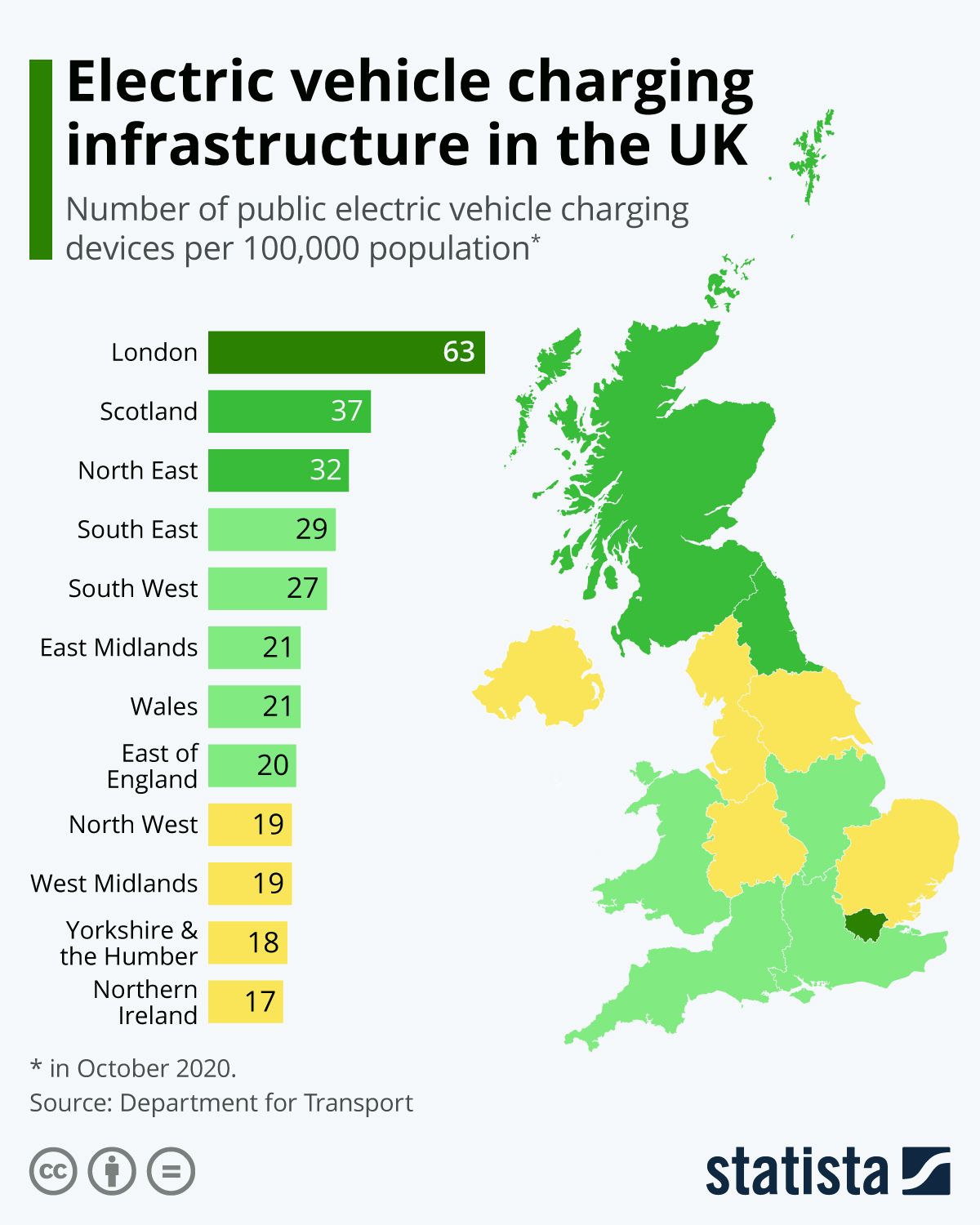
Armstrong, M. and Richter, F. (2020) Infographic: Electric vehicle charging infrastructure in the UK, Statista Daily Data. Available at: https://www.statista.com/chart/23448/public-electric-vehicle-charging-devices-per-capita-uk/?utm_souce=Blog&utm_medium=RSS (Accessed: 09 March 2024).